How to choose a company to build an AI agent on your manufacturing ERP
Pick a company that has already put an AI agent on an ERP that people use every day, ideally in manufacturing, and can show it working. Then check how it handles wrong answers, who will build yours, whether you can start with a small paid phase, and that you'll own the code. Test every candidate on questions your reports already answer.
By Curtosis · Updated
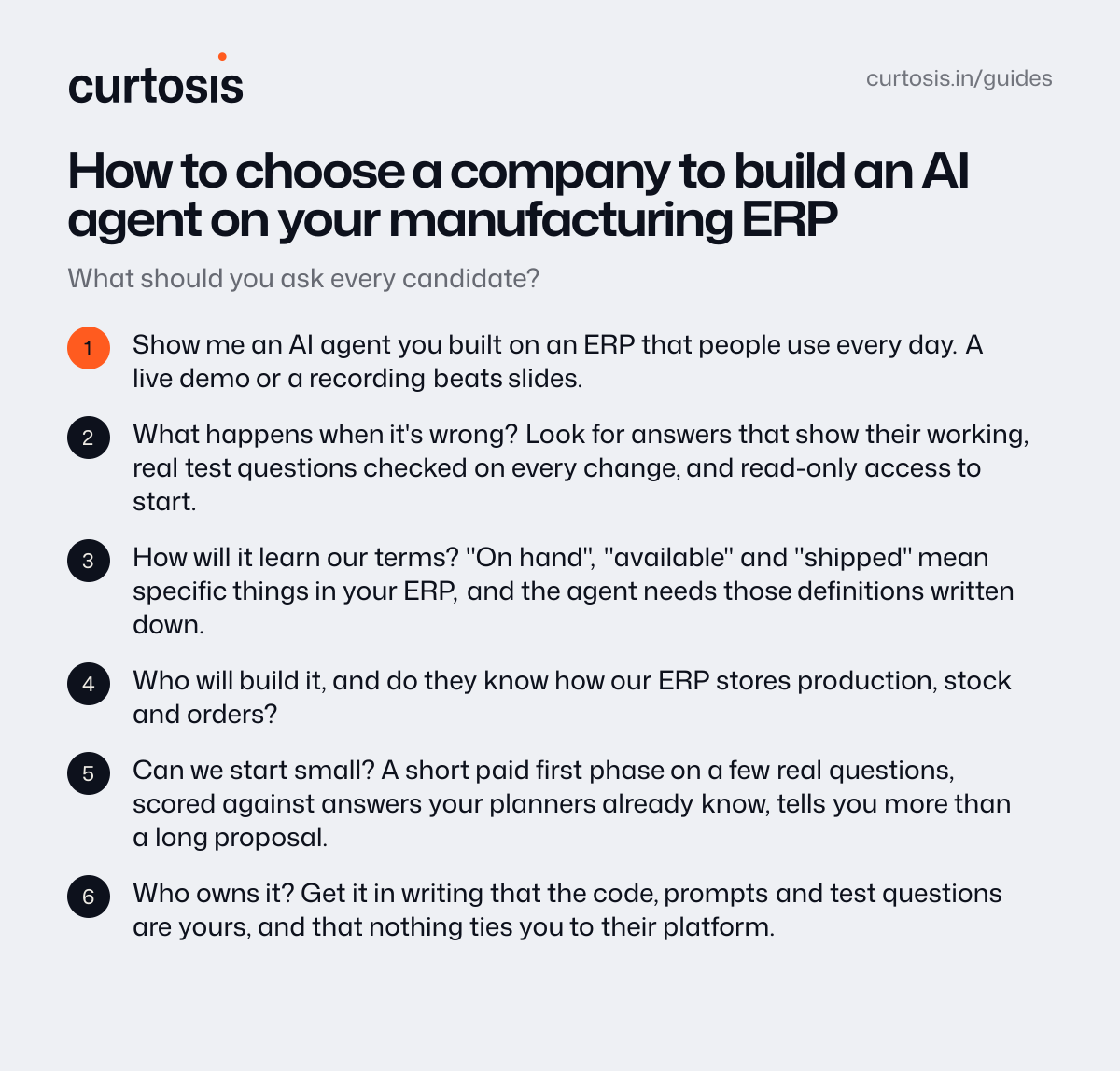
What should you ask every candidate?
- Show me an AI agent you built on an ERP that people use every day. A live demo or a recording beats slides.
- What happens when it's wrong? Look for answers that show their working, real test questions checked on every change, and read-only access to start.
- How will it learn our terms? “On hand”, “available” and “shipped” mean specific things in your ERP, and the agent needs those definitions written down.
- Who will build it, and do they know how our ERP stores production, stock and orders?
- Can we start small? A short paid first phase on a few real questions, scored against answers your planners already know, tells you more than a long proposal.
- Who owns it? Get it in writing that the code, prompts and test questions are yours, and that nothing ties you to their platform.
Your ERP vendor, a large integrator or a specialist?
| Option | Good for | Watch out for |
|---|---|---|
| Your ERP vendor or implementation partner | AI features built into your ERP, from people who know your setup | Built-in assistants may not answer the questions your team asks, and custom agents are often outside their work |
| A large integrator | Big programs across many systems and sites | Enterprise pricing, and smaller projects can get junior teams |
| A specialist AI agent company | One agent, built on your real data, without a big program around it | Check they've shipped on an ERP before, not only chatbots |
Is your data ready?
An agent is only as right as the ERP behind it. If production orders stay open after they're finished, or stock is corrected once a month, the answers will show it. A good team tells you this before building, and starts with the questions your data can answer reliably.
How do you compare candidates fairly?
Write down the questions your planners, buyers and managers ask every week, with today's answers from your reports. Ask each candidate's agent the same questions, and compare the numbers and how easy it is to see where each answer came from.
How Curtosis does it
Curtosis built Ask Destila for Destila-Isler, a manufacturer with multiple plants. About 1,000 people, from the CEO to the shop floor, ask it about production, billing, purchase orders and stock in plain English, and every answer shows its thinking, the code it ran and how many records matched. There's a demo video of it answering from live ERP data.
We start with the one job that eats the most time, build the smallest version that does it reliably, test it on your real data, and hand it to your team. You own the code, the data and the accounts from day one.
What we build runs in your accounts. Access is read-only by default, we don't keep your data, and training by AI providers is turned off.
Projects start at $1,000, at a fixed price agreed in writing before work starts.
Questions
Should we try our ERP vendor's own AI features first?
Yes, check them first. If they answer most of what your team asks, use them. A custom agent earns its place when you need your own definitions, data from more than one system, or answers that show exactly how they were worked out.
How long does it take?
With Curtosis, you get a written plan with a schedule and a fixed price after a free 20-minute call, and you see working software every week.
Can it run on our own servers?
Yes. When data can't leave your infrastructure, we use open-weight models deployed in your account.
How much does it cost?
With Curtosis, projects start at $1,000, at a fixed price agreed in writing before work starts. The price depends on what the agent connects to, whether it only answers questions or also takes actions, and where it runs.